Ben Butler · 13 September 2026
Thermal Dynamics of Stone in Passive Cooling Strategies for Contemporary Urban Structures
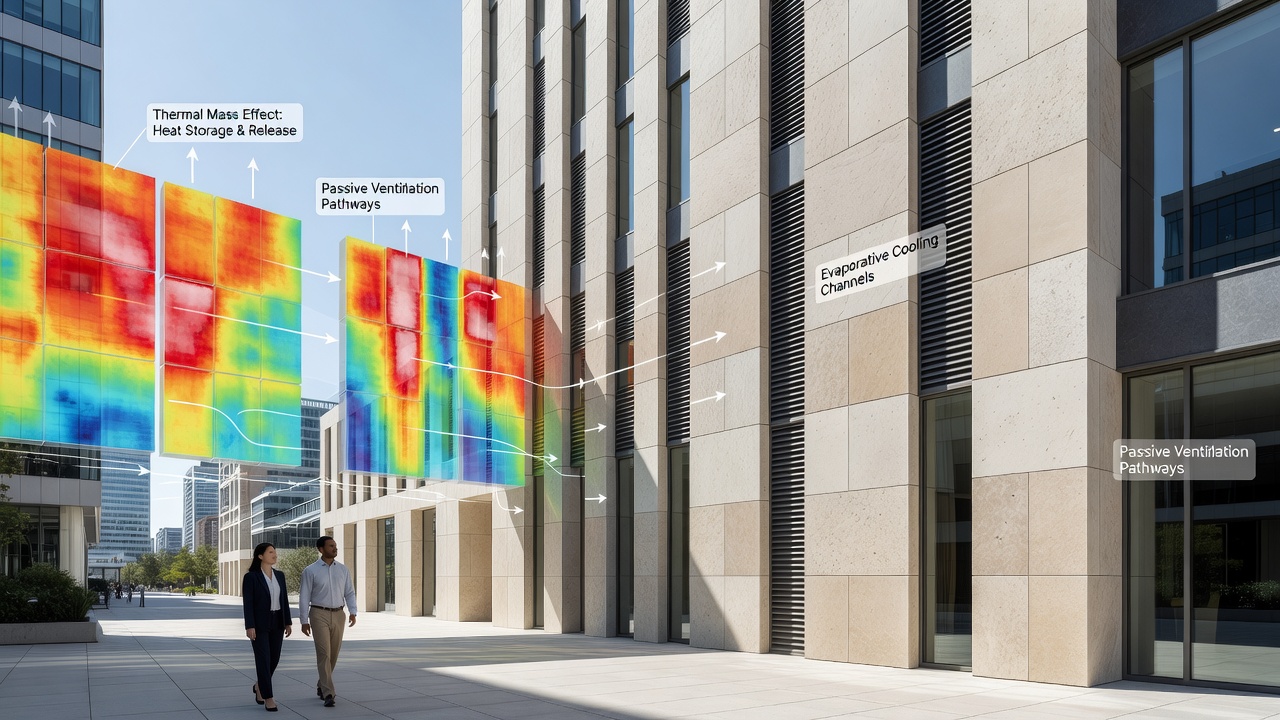
Stone materials exhibit high thermal mass that allows them to absorb heat during peak daytime temperatures and release it gradually during cooler nighttime periods, and this property supports passive cooling in contemporary urban structures where mechanical systems often face high energy demands. Researchers have documented how dense stone types such as granite, limestone, and basalt maintain stable internal temperatures when integrated into walls, floors, and roofs because their specific heat capacity exceeds that of many lighter construction materials. Data from building performance monitoring programs shows that structures incorporating stone elements can reduce indoor temperature fluctuations by up to 8 degrees Celsius compared to lightweight alternatives in temperate climates.
Core Thermal Properties of Stone
Thermal conductivity in stone varies by mineral composition, yet most varieties used in construction demonstrate values between 1.5 and 4 watts per meter kelvin, which enables efficient heat transfer within the material itself while the overall mass buffers external temperature swings. Studies conducted across multiple climate zones indicate that thicker stone assemblies delay heat transfer by several hours, aligning peak indoor loads with periods when outdoor air can provide natural ventilation. Observers note that moisture content further influences performance because water within stone pores increases effective heat capacity, although excessive saturation requires careful detailing to prevent long-term degradation.
Integration Methods in Urban Design
Contemporary architects embed stone in trombe-style walls and ventilated facades where air gaps between stone layers and interior spaces allow convective currents to distribute cooled air without fans. In dense city environments, stone paving and green roof combinations have been shown to lower surface temperatures on surrounding streets, and measurements from projects completed before September 2026 confirm reductions in urban heat island effects around individual buildings. External shading combined with stone thermal mass creates sequences where absorbed solar energy reradiates inward only after sunset, synchronizing with natural wind patterns common in metropolitan settings.
Performance Data from Monitored Projects
Long-term sensor networks installed in office towers and residential complexes reveal that stone-clad structures maintain relative humidity levels more consistently because the material adsorbs and desorbs moisture in response to ambient conditions. According to reports issued by the U.S. Department of Energy, buildings using stone thermal mass strategies achieved 15 to 25 percent lower cooling energy consumption in monitored test cases across the southwestern United States. In parallel, research coordinated through European Union sustainable construction programs documented similar efficiency gains in Mediterranean cities where summer cooling loads dominate annual energy profiles.
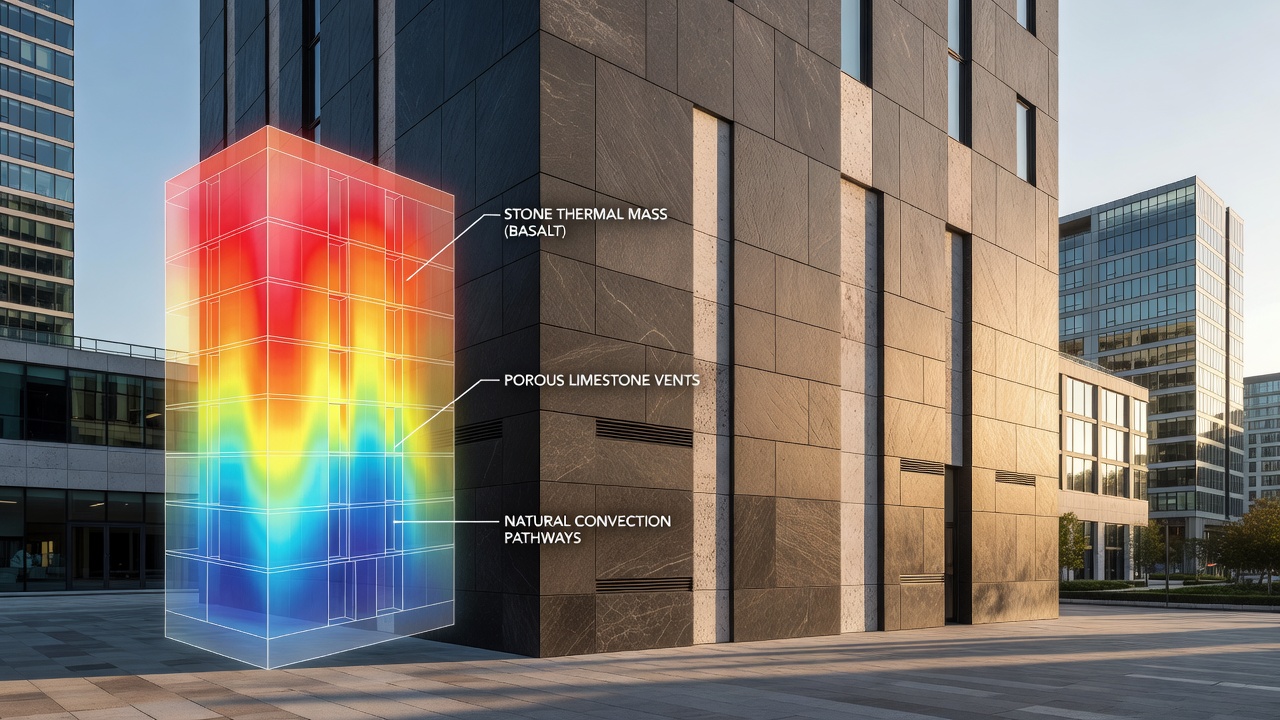
One documented installation in a mid-rise commercial building in Melbourne demonstrated that replacing conventional concrete with limestone panels increased the time lag for heat penetration from four hours to nearly nine hours, allowing night-time purging to reset the thermal storage effectively. Figures collected over three consecutive summers showed peak cooling demand shifted outside utility peak pricing windows, producing measurable operational cost reductions without changes to occupant behavior.
Material Selection and Detailing Considerations
Engineers evaluate stone density alongside color and surface finish because lighter-colored varieties reflect more incident radiation while darker stones absorb and store greater quantities of heat for later release. Joint design plays a decisive role since thermal expansion coefficients in stone differ from those of steel framing, and expansion joints must accommodate movement without creating thermal bridges that bypass the mass effect. Industry guidelines from organizations such as the International Masonry Institute emphasize continuous insulation layers behind stone cladding to maintain the mass on the interior side of the envelope where it interacts directly with conditioned spaces.
Limitations and Complementary Strategies
Stone thermal mass performs best when paired with adequate night ventilation, and sites lacking reliable wind or mechanical assistance for purging stored heat show diminished returns after initial absorption cycles. In extremely humid regions the material can retain warmth longer than desired, prompting designers to combine stone with phase-change additives or selective reflective coatings. Monitoring data continues to refine predictive models that account for urban canyon effects where surrounding buildings alter solar incidence angles throughout the day.
Conclusion
Thermal dynamics of stone continue to inform passive cooling approaches in urban construction as performance data accumulates from diverse geographic regions. Integration techniques evolve alongside advances in simulation software that predict daily and seasonal heat flows with increasing accuracy. Ongoing measurements through 2026 and beyond will further clarify optimal configurations for specific climate and density contexts.